
Junoon stands at a key moment in its journey, where the depth of classical lineage meets the demands of a rapidly changing world. As we grow across rural, urban, and digital spaces, we constantly face the question: How do we honour what we’ve inherited while staying relevant to today’s learners and audiences?
This reflection on preservation and evolution emerges directly from Junoon’s lived reality. It captures the very balance we hold every day, between the rigor of tradition and the need to adapt with integrity as the world around us transforms.
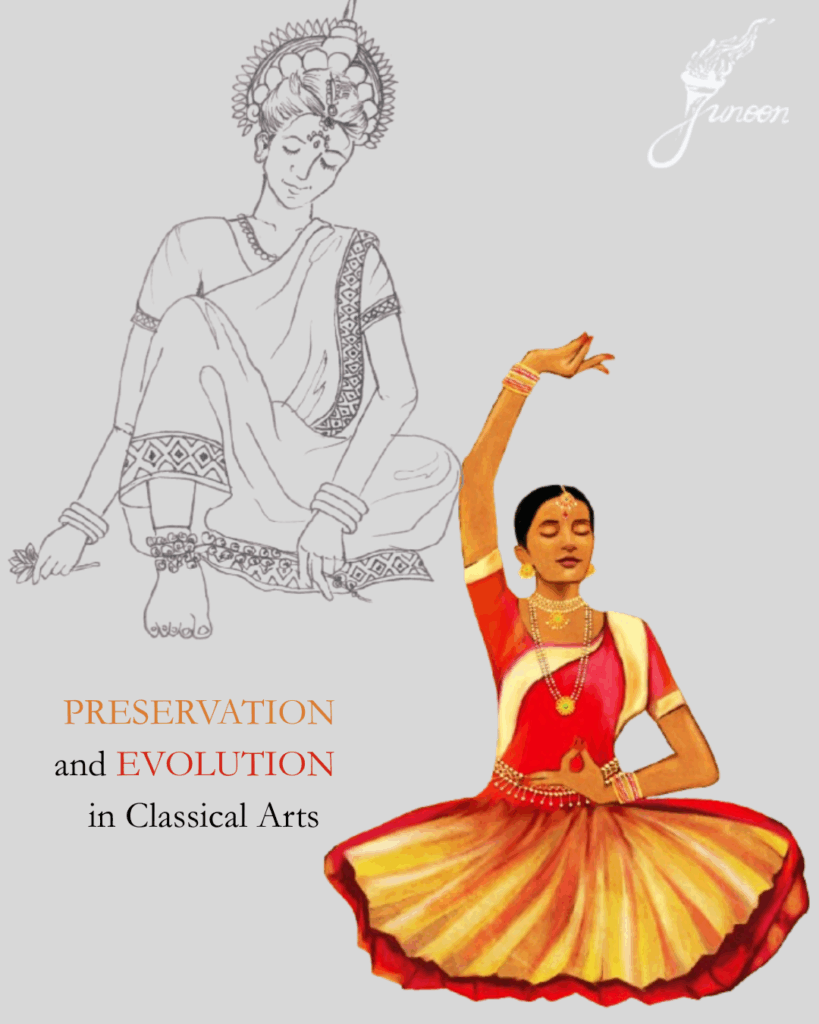
Classical arts stand at a fragile intersection: one road rooted in ancestry, the other reaching toward possibility. Every generation of artists inherits this crossroads, and with it, a persistent question, Should classical arts stay pure, or adapt to new audiences? The dilemma is not merely aesthetic; it is emotional, cultural, and deeply personal. It asks us to choose between the weight of history and the urgency of relevance.
On one side is the call of preservation. Classical arts carry the memories of civilizations: the footsteps of gurus, the vibrations of ancient texts, the discipline of lineages that refined each gesture and syllable over centuries. To preserve is to honor. To keep a form “pure” is to protect its internal logic, its grammar, its philosophy, its worldview. Those who advocate for preservation fear that change risks diluting the soul of the art. In a world obsessed with speed and spectacle, the long, slow apprenticeship of classical training can seem out of place. Yet without this commitment to depth, what remains of the art’s essence? Preservation asks us to pause, to resist the easy temptation of novelty, and to hold on to a cultural inheritance that cannot be rebuilt once lost.
On the other side is the call of evolution. Classical arts have never truly been static. They have changed with kingdoms, with patrons, with languages, with social realities. What we call “tradition” is itself a history of adaptations. In a global and digital age, artists confront new kinds of audiences, impatient, diverse, emotionally wired differently. If the forms do not speak to them, will they survive at all? Evolutionists argue that relevance is not betrayal but survival. They see innovation as devotion, an act of keeping the art alive rather than embalming it in nostalgia. For them, adapting to contemporary themes, new media, and fresh modes of expression is not dilution, it is continuity.
Bharata Natyam itself is a living example of this dilemma. Once nurtured within the Devadasi tradition and temple spaces, it later transformed through revivalist movements, modern institutions, and shifting cultural landscapes. What we practice and witness today is already a dialogue between past and present, a form that has retained its foundational grammar, yet has evolved in structure, presentation, and audience. Every Bharata Natyam Dancer feels this dual pull: the responsibility to preserve the rigor of adavus, the sanctity of abhinaya, and the philosophical roots of the Natyashastra, while also sensing the creative urge to explore contemporary themes and new aesthetic languages. The form stands as proof that preservation and evolution are not opposing forces, but companions that have shaped its journey across centuries.
Caught between these voices, the artist stands in tension. If they remain loyal to purity, they risk becoming inaccessible. If they adapt too much, they risk severing the thread that connects them to their roots. The dilemma is not about choosing one and abandoning the other; it is about living in the discomfort of both. It is the ache of wanting to belong to history while participating in the present. It is the responsibility of holding a legacy while sensing the pull of transformation.
Perhaps the real struggle lies in the fear of loss, loss of identity, loss of meaning, loss of depth. But there is also a fear of irrelevance, of watching an art form become a relic, admired but uninhabited. The dilemma asks us to weigh these losses against each other. It forces us to ask: What does it mean for something to be truly alive? Is it preserved in its original form, or in its ability to move, touch, and evolve with people?
There may be no final answer, and maybe that is the point. Classical arts survive precisely because each generation re-negotiates the boundaries between preservation and evolution. The dilemma itself is part of the tradition, an ongoing conversation between the past and the future, carried by those who stand in the present.
Written by
Nikita Rathod
Curriculum Development
The Junoon Foundation
Comments