
While working in Dhasa these past few weeks, we met a young girl who changed the course of our visit. Nine-year-old Sneha, who lives with epilepsy, had never attended our sessions before, despite being in the same school as many of our Junoon students. What began as a quiet moment of observation from her became a turning point for all of us. This is the story of how Junoon began working with her, what we’re learning along the way, and the early signs of healing we’re beginning to witness…
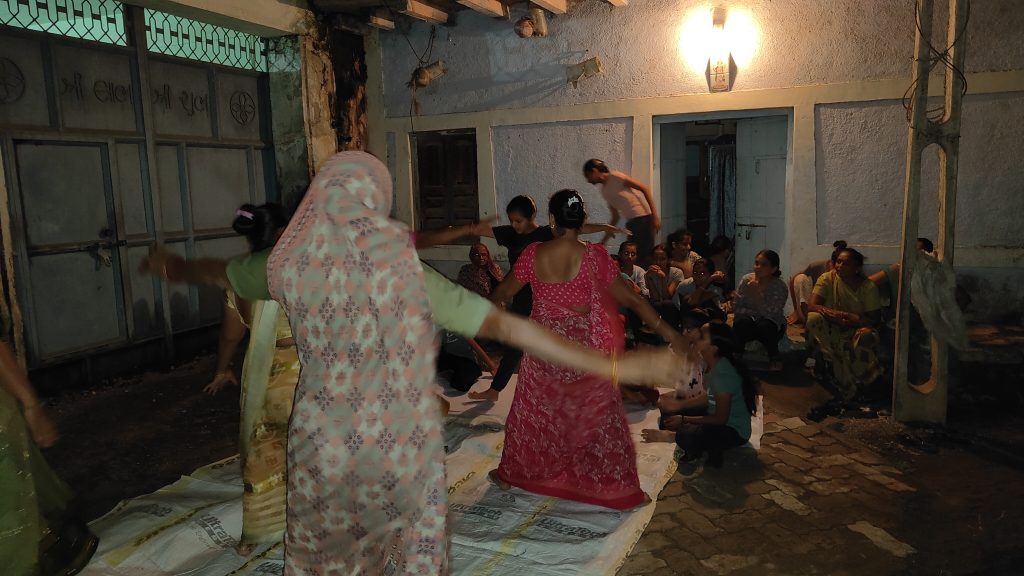
While we were out in the field in Dhasa, something unexpected and deeply moving happened. We were conducting one of our regular sessions with the women in the village, a space filled with conversation and movement. As we began, Mythili noticed a young girl quietly sitting at the edge of the gathering, simply watching.
There was something about her presence that drew our attention. After the session, we approached her family to understand more about her. That’s when we learned that she is nine years old and lives with epilepsy.
This was a moment of pause for us at Junoon. Epilepsy is a condition we haven’t formally worked with before, but we knew one thing for sure: if movement and creative expression could help her in any way, Junoon had to try.
What followed was a series of careful, thoughtful steps. We first sat with her parents to understand her medical history, how she was being treated, and what her current needs were. We consulted doctors, spoke with experts from our extended network, and held discussions with our Junoon team in Dhasa. Every step was guided by one core question: What would truly help this child, physically, emotionally, and socially?
What emerged from these conversations was both sobering and motivating. Despite being enrolled in the same primary school as many of our Junoon girls, Mythili, Junoon’s founder, had never come across her in any of our earlier visits. This revelation made one thing clear: this child had been living in near-complete isolation, with little to no interaction beyond her immediate family. A bright young girl, almost invisible to her own community. As we later came to understand, when she experienced an epileptic seizure at school, her teachers were unequipped to respond due to a lack of awareness and training.
Since then, we’ve started working with her gently, introducing movement in a way that’s deeply sensitive to her physical and psychological needs. Every session is approached with care, always checking in with her body, her energy, her comfort.
At Junoon, we are not on a mission to bring everyone into our sessions, we understand that not every space is right for every person. But when we come across a case like this, one that reveals both the potential for growth and the weight of neglect, we feel a quiet responsibility to do something.
We are still learning. We don’t yet have the full resources or training to support children with neurological conditions, but this experience is pushing us to build toward that future. We hope, in time, to create systems that can fully support children like her, where art, movement, and community care come together to offer a safe space.
For now, what we can offer is presence. We see her. We move with her. And in the small steps she takes with us, we’re beginning to see the early signs of correction, connection, joy, and belonging. Alongside this, we’re working to ensure she receives the medical attention and support she needs.
This isn’t just about one girl. It’s about what can happen when art meets empathy, and when someone who was once unseen begins to take up space, not just in a room, but in the eyes and hearts of those around her.
And that, we believe, is where healing begins.
Because Junoon isn’t just fire for fire’s sake, fire, as passionate as it is, is also healing in its warmth. It is a flame that burns with purpose, a passion that doesn’t scorch, but soothes. It warms. It lights the way. In its glow, there is courage. In its warmth, there is care.
Postscript
It has now been two weeks since Sneha began her journey with us. In this time, she has not experienced a single epileptic episode. This shift came after her first medical diagnosis, supported by the Village Trust, and the beginning of her training at Junoon.
Her sessions are led by our trainer, Hetal, who works with her with extraordinary sensitivity and care. The bond they’ve built has created something essential, a sense of safety. Sneha is not just following instructions; she is willing, open to moving, exploring, and being seen.
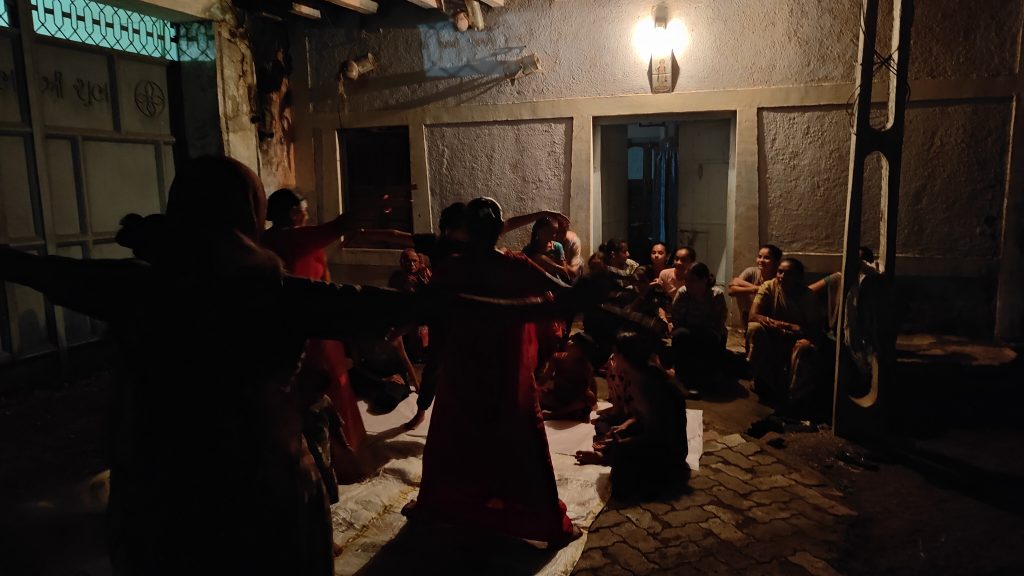
In a class with the other Mahilas, Sneha moved and stretched quietly, doing what she could, held by the rhythm of the group and the gentleness of the space around her.
Her second medical evaluation is due in two weeks. Until then, we continue, engaging her creatively and physically, minimising screen time, and encouraging her family to channel her energy into connection and activity.
It’s still early. But something has shifted.
And we’re here to hold that shift, with all the care it deserves.
Written By,
Nikita Rathod,
Curriculum Development
The Junoon Foundation,
India.
Comments