
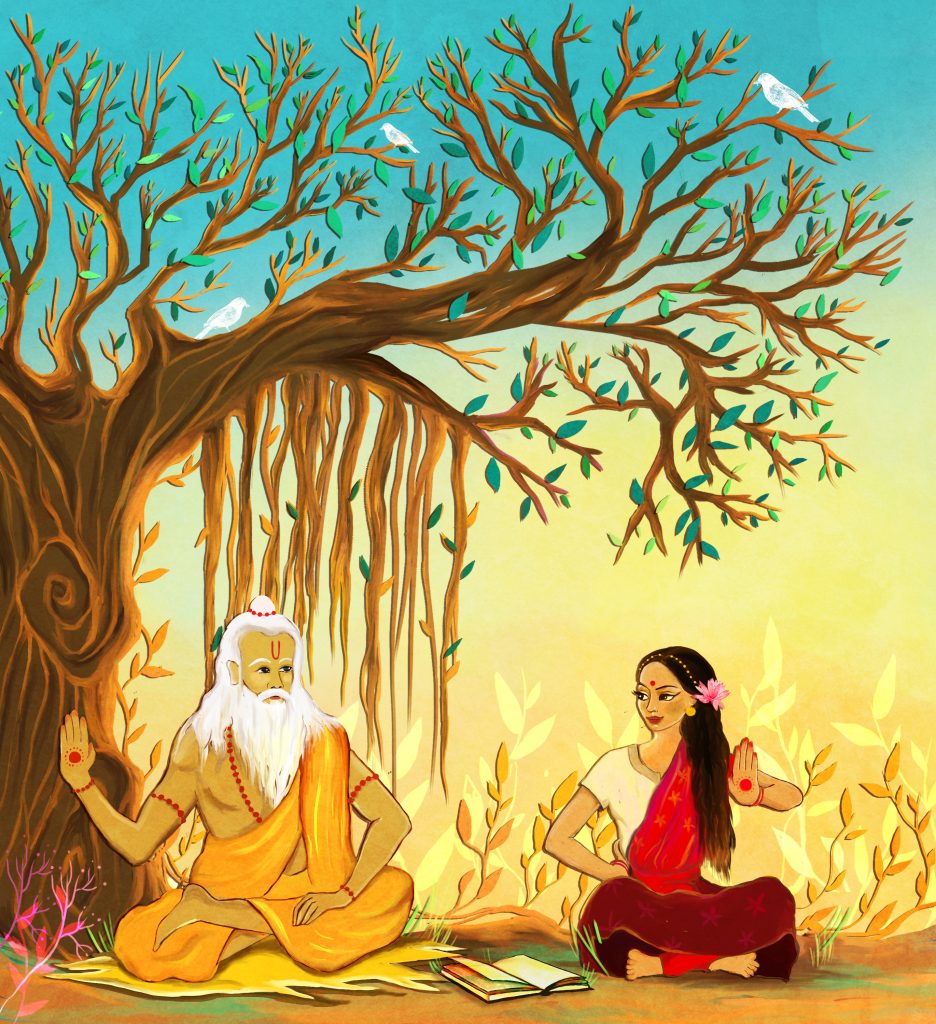
Ancient Greek philosophers adopted the stoic practice of self-assessing. Scholars like Pythagoras are the root and reason why we see value in journaling today. As a matter of fact, the ancient Gurukul system, whose historical antecedence to the era of Greek philosophy is widely known, had a similar assessment system to ensure Gurus and Shishyas (disciples) grew together. There were morning meditations and evening meditations to start and end one’s day with intention and reflection. As an educator who wishes to pioneer, with authenticity and relevance, the Gurukul system of education for Classical Art in the modern era, I must assume the role of a Stoic every now and then and see for myself the extent to which I embody these systems and philosophies myself. Is there room to do more, to be more, so we can be richer for it? For both reflection and improvement are a sort of penance…No mountains, no view.
As I make the trek into my mind, I find:
Assessment One:
1. I’d love to be more of a storyteller and scientist, making the Art both logical and magical for my children. I’d love to answer a lot of their “Why”s – a child’s favourite question (or shall we say: Weapon/Kryptonite).
- Why does it have to be done so many times?
- Why does it hurt?
- Why does everything hurt after I’ve done it?
- Why do we have to practice everyday?
- Why does it feel so weird to do?
- Why is there always a correction?
- Why did you say it was the last time if you were going to make us do it “another last time”?
As a trainer, I jolt myself into action to strengthen, to exercise my muscles (in body and mind). “It’s going to take a lot more than I thought to be an educator”, I tell myself, constantly re-arming and reinforcing my spirit for the kiddie battalion that can take me down in one fell swoop, one barrage of questions/moans and groans if I can’t keep up.
It is habitual for me to get into arguments with the children I teach. They make a good case for themselves. They ask smart questions. To avert practice even. Questions that fox me. Questions I did and didn’t ask when I was their age. Having said that, I don’t think children today have ever been the children we were. They’re older sooner. And that can be a good and sorry thing. I hope our arguments end up making them even more fascinated with and curious about the Art they are gradually coming to know. I hope our arguments convince them of the merit in striving for excellence. I hope, most of all, that they appreciate that the pursuit of perfection is one that can never be met; only gotten closer to. And that they stay young, bright-eyed and hopeful for their own sake, for the sake of the Art, never missing the forest for the trees.
Gurukuls (not only by way of their ancient locations) are the whole forest – a place that hosts a plethora of activity, systems, relationships, chains and explorations. I want my kids to have it all. And having it all definitely takes all you’ve got.
Technique and Repetition are boring. The feeling you feel when you start to improve is not. That improvement is an addiction they might have to develop as Dancers.
Stories are fun. Of resilience, willpower, endurance, of seeing and striving and triumph. If my kids hear more stories, they might want to have their own. I need to bring more stories to them, to bring them to their own stories. And have some more fun. Always, more fun.
Assessment Two:
2. Am I walking the talk? What am I doing in the here and now, that matches their feelings of struggle and strife?
It doesn’t matter what I did when I was their age. (It may have to me and my own practice but it doesn’t matter to the kids before me, wondering why they’re doing what they are.)
It matters what they watch me doing with them, beside them. Am I the Dancer I am asking them to be? What is the extent of my “Tapasya” right here, right now?
As teachers, we forget to focus on ourselves. We get so busy answering questions and building up our brood and worlds for them to live, dream and bask in that we ignore the explorations that we have to continue to make. The adventures and aches we might have to encounter to make the Art clearer and more navigable for our kids.
I am the Dancer I want my kids to be. Because I want to constantly push the boundaries of my own capacity and imbibe the Art more deeply. That’s the destiny I want us to share – our capacity and willingness for absorption and growth.
That is what singularly ensures the Gurukul thrives and the Arts, as a happy consequence.
Assessment Three:
3. The Gurukul system that I so resolutely wish to pioneer, is in many ways, a lifestyle choice that I must embody. Have I managed to both, segment and integrate my practice, my daily routine in coherence with the Gurukul way of life?
This is a tough one. And the property that makes this tough is: Time. Ancient Indians who lived and learned in Gurukuls had none of the pressures of connectivity, communication, complex human life and technological evolution, to deter them from living in the detached paradise of a forest of stories, schooling and freedom.
Nurturing passion, obtaining knowledge, becoming better, more practiced and more connected with one’s purpose cannot be approached with a uni-dimensional mindset. We have to hunt and gather in many places, in many different ways, to different degrees and intensities and in sundry combinations; to really get at the heart of various disciplines to perform optimally.
I have to exercise all my muscles – in brain and body. I have to read more, dig deeper. I have to listen to more than the sound of my own voice – to experts who have lived and died for my Art, for our collective freedom and capacity for expression. Experts who have left something behind or are creating as I write this. I have to reach moments in practice that hurt and then reveal. I have to reach higher and build more strength to aspire to more or more efficient functionality. What discoveries am I making while I reveal the world of Dance to my kids? They won’t come without that telescopic reach outside and inside. How inspired am I to inspire the next generation of Dancers? How charged am I to fire them up?
Teaching puts you in charge. You can’t do it without being inspired every day (or thereabouts…). You have to be able to sit under that tree, get into that studio, into that gym, on that running track, inside a book – really inside it, deep within a song or a movie or a poem and you have to bring that energy to create that artistic paradise, that forest of stories and strife and success for your children.
There is freedom in discipline. The one you teach and imbibe. And it involves many disciplines that are showed up to with resolve and intention, in good measure.
Assessment Four:
4. I make my kids listen to Classical Music – Western renditions and Ragas. And I ask them to tell me how it makes them feel. Dance is music made visual. I ask them if they can translate how they feel into movement.
I’ve begun to explore artists – new and old – myself, even more routinely than I did. Visualizing movement as melodies play in my ear. I need to constantly discover music that makes me want to move. That will make my kids want to move.
Music is the lifeblood of Dance. Every melody, every rhythm, every note, every lyrics sung stirs something different inside us all. I want my kids to know that there is a non-verbal language that they can employ to communicate these shifts inside them. I want them to be convinced that this language is the most effective one there is, one there has ever been – Dance.
Assessment Five:
5. Artistes make a quest for rare beauty. To find it, embody it, show it. “Rare beauty” is a more tempered phrase for perfection. The pursuit of perfection is difficult to rationalize for children. Until they watch this quest being embodied. They have to feel like they aren’t struggling, hurting, suffering from the pain of trying on their own. They have to feel supported and understood.
One way I choose to share the quest is by willingly struggling with them. The step is not theirs to learn. It is ours to decode together. The warm-up is not theirs to get over with. It is ours to fully lean into so we’re ready for the real sweat. The line is not their responsibility to arrive at. It is for them to derive by observing one that is as straight and long and unending as can be…
My version of Gurukul is a boardgame. Everyone has their turn. Everyone rolls a dice. Everyone moves steps ahead, sometimes stumbling and falling behind, but rolling again and finding ways to move up and across the board, encountering a new challenge – a new combination to nail and move past.
My kids and I are playing. With and for one another. There are wild cards – tricks and tips and prep – that get us wildly ahead. And then there are blocks we may be stuck on to chip away at further, with patience and perseverance, waiting for the right number – the right skill set, the right development, the right awareness, the right roll and move – to propel us forward.
There are levels in this game. Ones we cannot skip for the full experience of what we are learning. A guarantee that we will be able to keep and give these learnings for good if we go step by step.
Slowly but surely, the game provides a comprehensive educational experience. I must always make them want to play. It is our most natural state of being. A Gurukul may be the most natural environment for learning, teaching, growing and (the obvious!) playing. Because it encourages thought, action and commitment.
I must remain game. If anything, we will create the “perfect” playground for Art. Performance then is an everyday occurence. I see traces of this already. Thank goodness perfection is unattainable. It only means we can endlessly play…
The full and complete establishment of a Gurukul then, is part of my “Tapasya”. The routine self-assessment is not a buck I can pass, not one I want to. This starts with me. And stops at me. I have to answer to the heart that wants what it wants for the Arts.
This is Junoon.
Comments